A lightweight harness for HealthBench evaluations
Grading language models on realistic health conversations with physician-written rubrics, through any OpenAI-compatible API.
HealthBench is OpenAI's benchmark for how well language models handle realistic health conversations, with patients and with clinicians. Instead of multiple-choice questions, each of its 5,000 conversations comes with rubric criteria written by physicians. A model's reply is judged against each one.
I wanted to run it myself, on open models and cheap endpoints, with every judgement saved so I could read why a reply scored the way it did. This project is that harness: small, reproducible, and provider-agnostic.
Code and results: carlos-dev-research/evals-healthbench.
How it works#
flowchart LR
  A[HealthBench record<br/>conversation + rubrics] --> B[Model under test<br/>writes the next reply]
  B --> C[Grader model<br/>checks each criterion]
  C --> D[results.jsonl]
  D --> E[Score]
- Generate. The model under test receives the conversation and writes the next assistant turn (temperature 0.3).
- Grade. The grader model is called once per rubric criterion and must answer whether the reply meets it.
- Score. The criteria's points are combined into a score for each conversation, then averaged across the run.
Both models are reached through any OpenAI-compatible API, such as Groq, Ollama, vLLM or OpenAI itself. Switching provider or model is a .env change:
# Groq here; http://localhost:11434/v1 for a local Ollama
BASE_URL=https://api.groq.com/openai/v1
MODEL_TEST=openai/gpt-oss-20b
MODEL_GRADER=openai/gpt-oss-20b
Rubrics and scoring#
Criteria carry positive or negative points. For example, +8: mentions increased risk of falls, or −5: recommends an unsafe dose. With from the grader, each conversation scores:
This is points earned, with triggered penalties subtracting, over the maximum achievable. A single conversation can therefore score below zero. The run's score is the mean across conversations, clipped to .
Getting reliable JSON from the grader#
The grader receives the conversation, the reply and one criterion through a prompt template (GRADER.md). The template also handles a subtle point: for a negative criterion, the grader must report whether the undesirable behaviour occurred, not whether the reply was good.
Answers are constrained with a JSON schema:
response_format={
    "type": "json_schema",
    "json_schema": {
        "name": "grading_result",
        "schema": {
            "type": "object",
            "properties": {
                "explanation": {"type": "string"},
                "criteria_met": {"type": "boolean"},
            },
            "required": ["explanation", "criteria_met"],
            "additionalProperties": False,
        },
    },
}
Not every model or provider honours the schema, so as a fallback get_result scans the answer for the first balanced {…} block that parses as valid JSON. Requiring an explanation costs a few tokens, but it makes every verdict auditable later.
Results#
Each run gets a timestamped folder containing every prompt, reply and rubric verdict, plus a description of the run settings. I evaluated openai/gpt-oss-20b at low reasoning effort, graded by the same model, on random subsets of the main split (seed 40):
| Run | Conversations | Criteria graded | Score | Median |
|---|---|---|---|---|
test-2026-09-26 | 100 | 1,091 | 0.531 | 0.570 |
test-2026-09-27 | 200 | 2,295 | 0.500 | 0.532 |
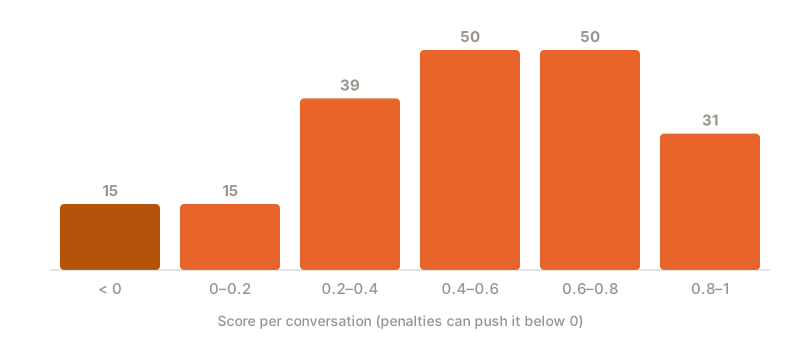
The run score hides a wide spread. In the 200-conversation run:
- 18 conversations scored a perfect 1.0, while 15 went below zero because penalties outweighed the points earned.
- The model met 64% of positive criteria (1,011 of 1,585) and triggered 32% of the penalty criteria (229 of 710).
The per-conversation files are what make this useful. Every low score can be traced to the exact criteria missed or triggered, together with the grader's explanation.
Limitations#
- Subsets. 100–200 of the 5,000 conversations. The drop from 0.531 to 0.500 between runs is within the sampling variance you'd expect.
- Self-grading. The grader here is the model under test. OpenAI's reference setup grades with GPT-4.1, and a stronger, independent grader is more trustworthy.
- Not comparable with OpenAI's published HealthBench numbers, for both reasons.
- Sequential calls with no retries, so large runs are slow and fragile.
What came next#
The harness was the first step. I later merged it into evals-healthbench-dashboard, which adds a local web UI for starting runs and browsing results. After that I rebuilt the whole tool as a cross-platform desktop app: see HealthBench Evals, a desktop app built with spec-driven development.
Resources#
- Code: github.com/carlos-dev-research/evals-healthbench (Apache 2.0)
- HealthBench paper (arXiv:2505.08775) and dataset on Hugging Face
- Model output in the result files is unreviewed and is not medical advice.